Posts

Rethinking Assessment

Image
As part our final M.Ed. Capstone course entitled , Collisions, Disruptions, and Diffusions , we were presented with the challenge to facilitate a seminar based on an area of personal interest in education. Over the past 3 years, themes of technology integration and teaching through inquiry have become central in my journey, as I have aimed to link theory and practice. Through this experience I have come to the realization that assessment needs to change along with teaching practices. This same wondering came to light for my Master Class co-facilitator, Jenny Loebsack. As we began preparing, we understood that this topic would lead to some collisions, disruptions, and diffusions in our discussions. Our goal was to elicit reflection and discussion on current assessment practices, how they might enable/interfere with learning, and how we might begin rethinking these practices in light of what we know and understand about learners. As stated during our seminar by a classmate, we need to ...
Math Learning - "Just In Time"

Image
What do a box of recycling and an excerpt from a Bailey School Kids chapter book have in common? They can both lead to "Just In Time" learning.  Embracing the spontaneous learning moments that happen throughout the day is not always an easy task. Thoughts about 'what's next' and time pressures often get in the way of this. What I have come to find is that when we stop, think, act, and reflect on these moments we are not only facilitating meaningful learning for our students, but also modelling an inquiry stance. This is what it looks like and sounds like to be a critical thinker and learner in the world.    In Literacy, we are learning to Stop and Jot about our thinking. This includes making predictions, asking questions, connecting with characters, and identifying themes. Think Alouds and guided reading sessions are helping students maintain meaning as they read and 'think about their thinking'. We are currently reading a Bailey School Kids ...

Giving Good Advice- Peer Feedback in Primary

Image
In a recent M.Ed. class our topic was on conducting a peer review for scholarly writing. We discussed how important it is to set aside adequate time, ensure appropriate tone (difference between negative and constructive feedback), and going beyond the micro level issues (conventions) to macro issues (ideas, evidence, organization) when reviewing writing samples. Each of us had a very different take on what it feels like to give and receive feedback which was an interesting point of discussion. Feelings included apprehension of presenting writing/fear of judgement, lack of experience providing critiques, and insecurity offering true critical advice. This got me thinking - wouldn't all this be true for peer feedback, even with the youngest of learners? When I returned to school the next day, I took a closer look at some of the feedback grade 2 classmates had been giving each other in writing (we often offer stars and wishes for each other). I saw a lot of "Good job!", ...

Reflections to Start a New Year

Image
Over the past few days I have been thinking a lot about where I am, how I got here, and where I'm going. Preparing to begin my final M.Ed. capstone course has prompted me to look back at projects, posts, and reflections from 2014. A large portion of this course is devoted to gathering artifacts based upon program goals and reflecting on their personal and professional impact. I can't help but think back to some of my more recent 'ah has'. This past year I have learned about the value of play and importance of mindfulness not only for my students but also for my own well-being. It is through being in the moment that we are able to make connections with others and experience unexpected learning opportunities. The minute to minute nature of being a classroom teacher can sometimes stand in the way of this. A goal for myself this year is to remember this and truly be in the classroom. This past year I also had the opportunity to be involved with a number of WCDSB committees...

Reflections on Collaborative Inquiry

Image
This school year I was invited to participate in the EPCI (Early Primary Collaborative Inquiry) working group along with two of my teaching partners. Earlier today I attended the regional face-to-face with other members of our board's learning team. We had the opportunity to engage in rich discussions with other educators from around our region, share our learning, challenge each other, and think about building capacity moving forward.  Our guiding question Here are some of the pivotal learning moments from our collaborative inquiry: Student learning is improved when: - teachers reflect upon questioning and feedback/wait time (sometimes unnecessary feedback/prompting stops student thinking short) - student are engaged in rich learning tasks (low-floor/high ceiling tasks) - learning is connected and and embedded in a meaningful context (real world connections, vocabulary use across strands/subject areas) - students become a part of pedagogical documentation and re...

Google Forms: Bringing Efficiency to Assessment for Learning

Image
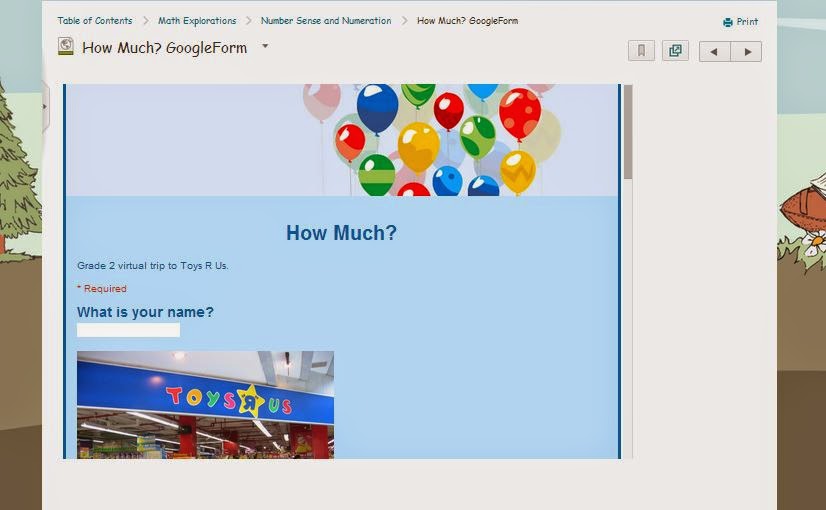
As a diagnostic activity for money, I created a simple Google Form that embedded mathematical BIG IDEAS within the context of a Virtual Field trip to Toys R' Us. Questions included counting a collection of coins, adding money amount, and creating change. Google Form - Money Diagnostic The students were very much engaged in the task and were able to work through the form independently. Embedding the form directly into our D2L Blended Learning Space allowed for easy access. I have noticed that my students have become my tech learning partners - always up for trying out a new digital tool! But ... it wasn't the actual filling out of the form that was transforming (I could have easily done a similar pencil and paper assessment). The true value of using Google Forms comes in the data collected and what you can do with that data! A spreadsheet is automatically populated as students submit their form. This can be used immediately to inform practice. Within seconds, I could id...

A Blended Learning Approach to Teaching Social Studies

Image
This past week the Grade 2s continued their work preparing presentations about countries using Google Drive. What really amazed me was the ability to use the comment feature to provide immediate feedback that was relevant and purposeful for the students. As they were working, I posed questions to direct their next steps. I was not sure how this would work, so I didn't let them know ahead of time that I would be doing this. To my delight, students replied to my comments and made additions to their slides in realtime.  Afterwards, they remarked at how much it helped them "think about what's next". They also asked if they could comment on each others work!  This caused me think more about the purpose of feedback and how informal feedback such as this helps students see learning as a journey.  Here is a great read that speaks to this: Learning Dispositions blog post - from MindShift Next week, we will be sharing our work with another Grade 2 class who also used Go...