Posts

Reflections on Collaborative Inquiry

Image
This school year I was invited to participate in the EPCI (Early Primary Collaborative Inquiry) working group along with two of my teaching partners. Earlier today I attended the regional face-to-face with other members of our board's learning team. We had the opportunity to engage in rich discussions with other educators from around our region, share our learning, challenge each other, and think about building capacity moving forward.  Our guiding question Here are some of the pivotal learning moments from our collaborative inquiry: Student learning is improved when: - teachers reflect upon questioning and feedback/wait time (sometimes unnecessary feedback/prompting stops student thinking short) - student are engaged in rich learning tasks (low-floor/high ceiling tasks) - learning is connected and and embedded in a meaningful context (real world connections, vocabulary use across strands/subject areas) - students become a part of pedagogical documentation and re...
Google Forms: Bringing Efficiency to Assessment for Learning

Image
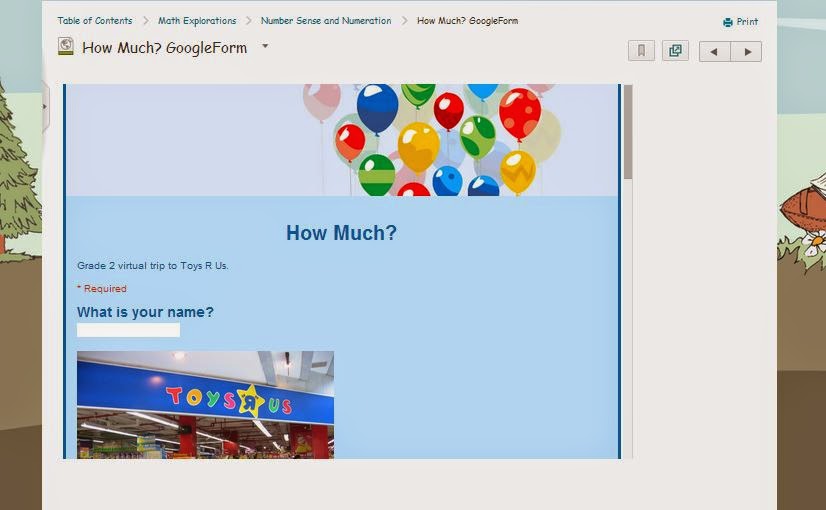
As a diagnostic activity for money, I created a simple Google Form that embedded mathematical BIG IDEAS within the context of a Virtual Field trip to Toys R' Us. Questions included counting a collection of coins, adding money amount, and creating change. Google Form - Money Diagnostic The students were very much engaged in the task and were able to work through the form independently. Embedding the form directly into our D2L Blended Learning Space allowed for easy access. I have noticed that my students have become my tech learning partners - always up for trying out a new digital tool! But ... it wasn't the actual filling out of the form that was transforming (I could have easily done a similar pencil and paper assessment). The true value of using Google Forms comes in the data collected and what you can do with that data! A spreadsheet is automatically populated as students submit their form. This can be used immediately to inform practice. Within seconds, I could id...

A Blended Learning Approach to Teaching Social Studies

Image
This past week the Grade 2s continued their work preparing presentations about countries using Google Drive. What really amazed me was the ability to use the comment feature to provide immediate feedback that was relevant and purposeful for the students. As they were working, I posed questions to direct their next steps. I was not sure how this would work, so I didn't let them know ahead of time that I would be doing this. To my delight, students replied to my comments and made additions to their slides in realtime.  Afterwards, they remarked at how much it helped them "think about what's next". They also asked if they could comment on each others work!  This caused me think more about the purpose of feedback and how informal feedback such as this helps students see learning as a journey.  Here is a great read that speaks to this: Learning Dispositions blog post - from MindShift Next week, we will be sharing our work with another Grade 2 class who also used Go...

Integrated Learning

Image
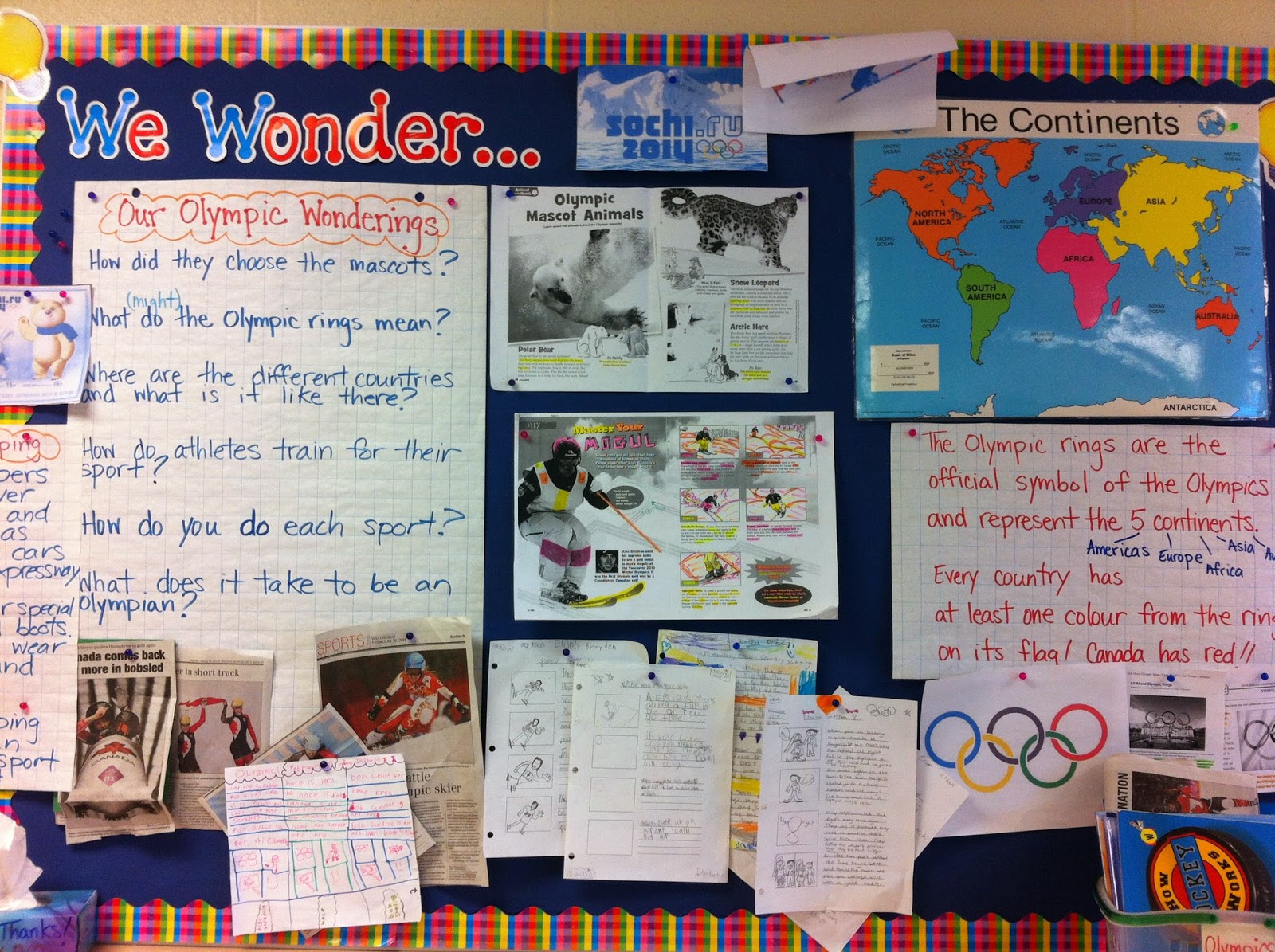
The Power of Integrated Learning I have been curious about what integrated learning might look like in a primary classroom and the impact it may have on student engagement and learning. The Olympics seemed to be a perfect opportunity to give it a try. Relinquishing control over the what and how of learning enabled the students to explore topics that interested them. Their own "wonderings" guided our daily activities. These included researching how Olympians train for various sports, the meaning of symbols such as the Olympic rings, and Sochi Olympic mascots. We also agreed that tracking Olympics metals was very important. Using the Sochi iPad app, we translated raw data into pictographs and bar graphs. Towards the end of the Olympics during a classroom community circle, a student shared how they felt they had learned a lot but it was never boring and they liked doing the same 'kind of stuff' throughout the day. It wasn't just doing math, or readin...

On being a connected educator

Image
My journey in the world of education has always been rich with professional development opportunities. Just as we ask students to connect their learning, I believe educators need to do the same. As a new teacher I was surrounded by skilled and talented mentors who highlighted for me the importance of developing positive relationships with students and creating a learning atmosphere where students feel they are valued, respected, and free to take risks. As a young educator I also registered for multiple additional qualification courses which helped solidify my understanding of content and pedagogy. Since this time I have been fortunate to be a part of collaborative learning teams at the school and board level that have challenged me to be a more reflective educator- adapting best practice to meet the changing needs of students. It has been through collaborative learning teams that I have begun to adopt an inquiry stance with my own teaching practice. This has allowed me to dig deeper in...

Getting Started with Blended Learning

Image
This January I began using D2L's learning management system with my Grade 2 class.  I have used a combination of GoogleDrive and TeacherWeb in the past, but was curious about how eLearning could foster greater student engagement and provide a platform for collaboration. By modifying the navigation bar and homepage design, I was able to create an easy to follow space linking content and discussions. Introductory activities have included watching videos from Learn360 about polar bears and migratory birds with follow-up discussion questions about how animals survive in the winter. Students also explored a resource from the Ontario Education Resource Bank that describes animal adaptations in greater depth and enables students to apply their knowledge by examining an interactive map with Canadian animals and asking them to select the matching adaption. To support our current math inquiries about time, students also explored an OERB activity about "Buster Beaver'...

'Ah ha' Moments from 2013

Image
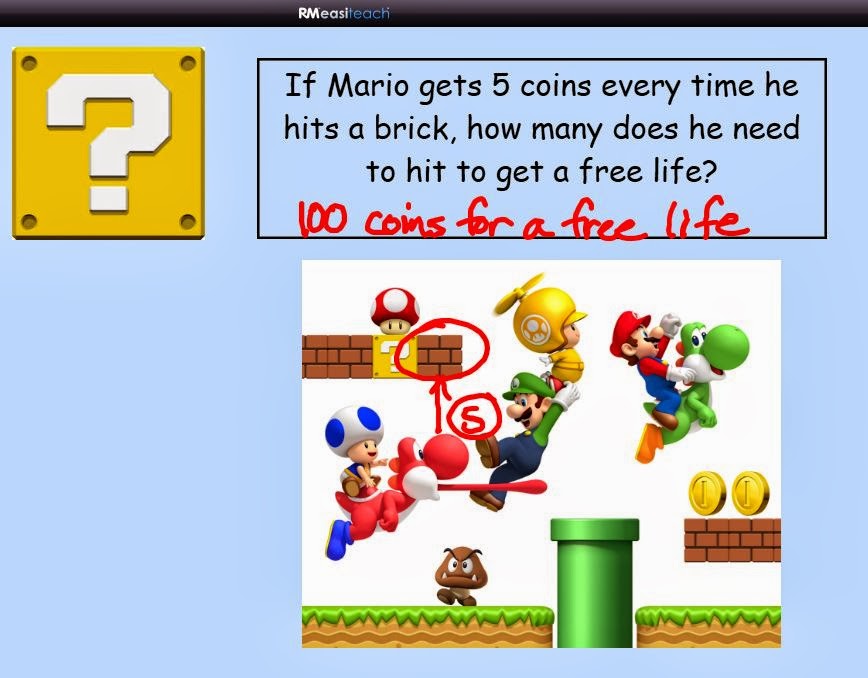
With the end of another calendar year, I have been thinking a lot about teaching 'ah ha' moments from 2013. Here are a few of my favourites.  1. Make it real and relatable! Earlier this school year, I was inspiried by a conversation with my Grade 2 students about the video game Super Mario Bros. I embedded this into our learning about number patterns and relationships. They were totally engrossed in this inquiry. The context was real to them, which made the learning meaningful. What surprised me the most was how they took this inquiry and extended it further.  After solving and proving the original question, they asked what would happen if Mario already had some coins. This led to discussions about possible tools to help solve this problem, as well as identification of patterns within the hundreds chart when skip counting from various starting points.  All possible because of meaningful engagement.  2 .   Give them tools to be successful. I a...